
Into The Newsroom: Two J-School Juniors Win NATAS Scholarships

One day in JRNL 100, Mason Birgenheier stood in front of the class and announced that KPAX-TV was looking for production help. He had been working afternoon shifts at the station, serving as a production assistant, when Ethaniel Fitzgerald heard his announcement. Fitzgerald soon landed a position at KPAX, helping manage and produce The Morning Show, clocking in at 3am and then leaving straight from work to go to class.

NATASNow, three years later, both Birgenheier and Fitzgerald have won NATAS scholarships for their dedication to the broadcast industry.

The goal of the National Academy of Television Arts & Sciences (NATAS) scholarship program is to support promising students in their pursuits in the television field of journalism. As part of the award, winners travel to Seattle, Washington in June for further recognition and to go behind the scenes in a larger newsroom.

The UM School of Journalism has a long history of broadcast majors receiving NATAS scholarships. Of this year’s winners, Ray Ekness, Professor & Director of Student Success, said, “Both Ethan and Mason are exactly what the NATAS folks are looking for. They’re smart, take feedback well, are willing to learn and have been working hard at local television stations.”
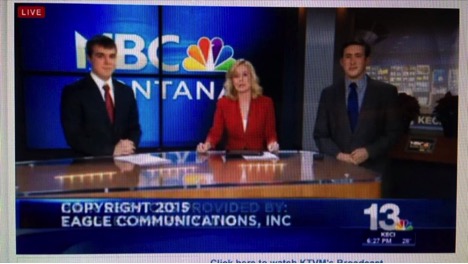
Ethaniel Fitzgerald delivers the news with fellow reporters for NBC Montana.

Currently, Birgenheier and Fitzgerald work for KECI-TV, a local subset of NBC. Birgenheier mostly focuses on the production side and said that the team’s atmosphere revolved around the word ‘hustle.’ “It’s so fast-paced and you’re constantly on your toes,” he said. “But when something happens, you’re the first ones to know.”

As someone who grew up in Missoula, Birgenheier said that he enjoyed using his technological skills to keep people up to date with the local news. “I like knowing what’s going on in my community,” he said.

While Fitzgerald also has substantial production experience, lately he’s been working as KECI’s weekend sports reporter. He said the position functioned at a different pace than the news, but it was still fun and exciting.

Fitzgerald won NATAS’s specific Tricia Moen Scholarship, which emphasizes the producing and writing aspects of broadcast journalism. This scholarship honors Tricia Moen, a producer at KOMO-TV in Seattle, who continued to work even after being diagnosed with Stage-4 cancer. During the NATAS application process, Fitzgerald researched her story and felt touched by her journey. “I had goosebumps,” Fitzgerald said. “I wanted to be better at my job because of her.”

Yet Fitzgerald’s inspiration at the J-school came from Ekness, who gave him technical advice and pushed him to be a better journalist. “He’ll do anything for his students,” Fitzgerald said.

Birgenheier agreed. “I’m thankful to a lot of people, but especially Ray,” he said. “I owe a huge kudos to him.”

“I’m very proud of what they’ve accomplished,” Ekness said. “I’m looking forward to the great things they’ll do in the future.”

For Fitzgerald, the future revolves around finding a news team that works well together. “I like anchoring and being behind the scenes,” he said. “I want to have a lot of skills, and [someday] I’d like to just be able to roll the dice and go there.”

When Birgenheier started at UM, he didn’t see himself as a journalist. “But now that I’ve found it, I know it’s always been a part of me, “ he said. “I hope to anchor someday, and I feel more confident after winning this scholarship. It’s taken a lot of hard work to do this and to feel like someone actually noticed, is awesome.”

As both students head into their senior year, they plan to keep working at KECI and gain as much experience as possible from their jobs and from their classes. In 2016, the UM School of Journalism was ranked top-ten in the nation, and Birgenheier felt obligated to keep that reputation strong.

“We’re pretty good at what we do,” he said. “It’s up to us to carry the torch.”

Missed the 6 o’clock news? Follow Mason Birgenheier on Twitter, Instagram or the Montana Race Project for his contributions to local stories, and follow Ethaniel Fitzgerald on Twitter to catch up with the latest news in Missoula.

By Jana Wiegand

J-School Grad Student Wins Best In Festival For Radio Piece

photo of Ouellet working in the studio
Photo by Shanti Johnson.

From the blue lights and glow-sticks at The Great Northern Bar in Whitefish, Montana, graduate student Nicky Ouellet followed a band backstage to understand the mission behind their music. Ouellet’s subsequent radio story, “An ‘80s Cover Band With Global Dreams,” recently won Best in Festival in the student news competition for the Broadcast Education Association’s Festival of Media Arts.

“This is one of my first audio pieces,” Ouellet said. “For it to receive national recognition like this is really overwhelming, and I’m really honored.”

The story emerged from Assistant Professor Jule Banville’s Advanced Audio Skills class, when Banville prompted her students to incorporate music into a radio piece. “I wanted mine to be more than just a story about a band,” Ouellet said. “And the New Wave Time Trippers immediately came to mind.”

While the band came together for their mutual love for ‘80s music, they also wanted to find a way to be able to live off their “Rocky Horror Picture Show” style performances. Members of the New Wave Time Trippers told Ouellet that they hoped to turn these occasional night gigs into a full-time job by playing at corporate events and landing a regular show in Las Vegas.

“I thought it was a really interesting combination of the artsy, but also the business savvy,” Ouellet said.

For her, capturing a sense of place was equally as important as recording the essence of the Time Tripper’s music. Ouellet plugged a Marantz kit directly into the bar’s sound system to record clean copies of the songs and set up a secondary recorder to capture the crowd’s experience. After taping two of their shows, one in Whitefish and one in Missoula, Ouellet spent hours listening to the footage, recording her own narration and trying to keep the story under five minutes.

“Most of the challenges were really just keeping it tight and clean and focused,” Ouellet said. “That’s where Jule, my professor, came in and helped me kill all of my darlings, which was a really tough process because there were a lot of good ones.”

“I loved that story, and it will make you happy if you listen to it,” Banville said. “It had this signature mix where Nicky blended her writing and narration with interviews, and of course, great songs.”

The intimacy of radio originally drew Ouellet to the medium. She said the power of each story to delve inside someone else’s head made her change the way she saw the world. “You kind of lose sense of the thing directly in front of you, and it’s like this whole world of your mind and that of the story-teller are blended,” Ouellet explained.

Since the Time Tripper piece, she and Banville have been working closely together on Ouellet’s professional portfolio, which she will defend in May to receive her master’s degree in journalism. Her portfolio includes both written and audio pieces, examining how Native Americans manage natural resources on tribal lands. Ouellet is currently applying to jobs and fellowships for after graduation, and she hopes to find a position that lets her continue to use both print and radio.

“I’ve met very few people who work a story like Nicky Ouellet,” Banville said. “She’s going to do amazing things and just kill it as a journalist who can do it all.”

To hear more about Nicky Ouellet’s Best in Festival piece and the production process, watch her video interview on the School of Journalism’s Vimeo account, or click here to read the transcript of her interview. See more of Nicky Ouellet’s work in print and radio on her blog’s portfolio.

Stay up to date with more UM J-School radio pieces by listening to Jule Banville’s podcast series Last Best Stories.

By Jana Wiegand

Nick Ut Reflects On His Career: From Hell To Hollywood

When airplanes flew low over Nick Ut’s home in Los Angeles, California, his house shook and reminded him of the Vietnam War. Born in Long An, Vietnam, Ut started working for the Associated Press (AP) when he was 16 years old, following in the footsteps of his older brother who had recently died while on assignment in 1965. Ut inherited his brother’s cameras and taught himself photography by working in the AP’s darkroom and shooting protests in Saigon.

His editors’ quickly recognized Ut’s skill and sent him into the field to cover the Vietnam War. Ut’s brother’s voice echoed in his head. “I make a picture for you, my brother, to change the war,” Ut said.

Ut-presentation
Nick Ut checks the screen as his photos scroll by in front of a large audience at the University of Montana. Photo by Alyssa Rabil.

Ut spoke at the University of Montana on March 9, as part of the 100-year anniversary of the Pulitzer Prize and to celebrate his 50 years working for the AP. In 1973, just 21 years old, Ut won the Pulitzer Prize for Spot News Photography. He called the picture “The Terror of War,” but others referred to it as “The Napalm Girl.” Dean of the School of Journalism, Larry Abramson, walked past that picture dozens of times, printed on flyers, in the weeks leading up to Ut’s visit. “Even on the Xerox copy, I’d stop and see something new every day,” Abramson said.

The picture features children running down a road in Trang Bang, Vietnam after a napalm attack on the village. The “Napalm Girl” was Phan Thj Kim Phuc, who ran away from the village, arms outstretched and completely naked. Ut shot several frames of her and the other children fleeing before he understood how badly Phuc had been burned by the attack.

“I saw skin coming off her body,” Ut said. “And I thought, oh my God, I don’t want her to die.”

Ut set his cameras aside and started dumping water on Phuc to try and help her. However, he knew that Phuc and the other children needed professional help, so he transported them in the AP van to the nearest hospital. Since then, Ut said, “I keep looking to help the children.”

He’s sent food and clothing to families in Vietnam impacted by the use of Agent Orange, and he’s kept track of Phuc since the day of the attack on June 8th, 1972. Phuc began to refer to Ut as “Uncle Nick” over the years, as he continued to photograph her skin’s recovery and support her as a current U.N. Goodwill Ambassador. Thanks to Ut’s photos, the two have also spoken to media around the world about the cruelties of war. Ut said, “We met the Queen of England, me and her.”

Wittpenn_NickUt2
Sally Stapelton alerted faculty to Ut’s upcoming birthday. J-school faculty and students celebrated with him after class. Photo by Brontë Wittpenn.

Pollner Professor, Sally Stapleton, and Ut’s friend from their shared time at the AP, said, “He takes ‘No means nothing’ better than anyone I know.”

Ut said he’s “always with camera” to be prepared for unexpected stories. In contrast to his time covering war stories, Ut said, “I tell you, Hollywood, it’s a lot of fun.” Now based in Los Angeles, Ut’s shot court cases involving Michael Jackson, Lindsay Lohan and Paris Hilton. He also captured the “Super Blood Moon” of 2015 and unexpected L.A.P.D. street arrests.

For the UM journalism students in the audience, Ut said the key to a great photo evolves from four elements: keep moving, try different angles, keep shooting and capture different emotions.

The next pressing assignment for Ut will be covering Nancy Reagan’s funeral Friday, March 12th.

Stay up-to-date with Ut’s work by following his Twitter and Instagram accounts.

by Jana Wiegand