UM J-School Professor Publishes Hard-Hitting Investigative Report On Medicare Fraud

Before Assistant Professor Joe Eaton joined the faculty at the University of Montana School of Journalism, he was an investigative reporter at the Washington D.C. based Center for Public Integrity, where he specialized in sifting through data to find stories of things gone wrong with America’s health care system. Today he passes his skill at investigations on to his students, but he hasn’t given up chasing his own stories.
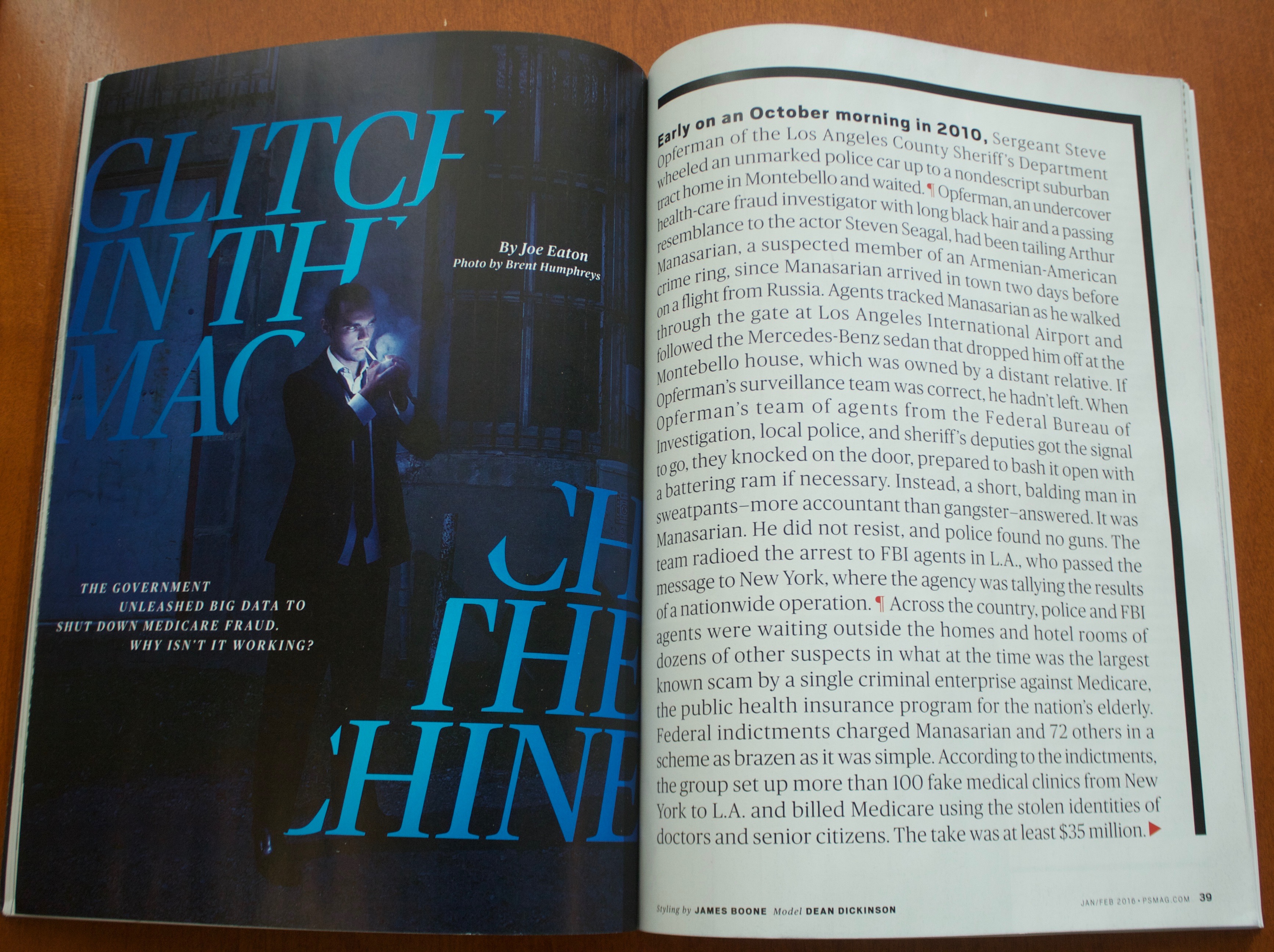
photo of article layout in magazine
Above: Eaton’s article as it appeared in print. Photo by Andrew Graham.

This January, a story by Eaton about the government’s inability to stop widespread Medicare fraud ran on the front cover of Pacific Standard, a magazine with national distribution that is based out of Santa Barbara, California. To get the story, Eaton relied on sources and knowledge from ten years of covering the topic.

Eaton knew that scamming Medicare is relatively simple, given the scope of the program and the porousness of the review process for insurance claims. An expert Eaton quoted in the story estimated that the medicare fraud rate could be as high as 20 percent, of a program that spends $600 billion. When a 2010 bill passed through congress and mandated that Medicare follow the lead of the credit card industry and use big data tools to prevent fraud, Eaton’s ears picked up. “I wanted to take everything I know about Medicare and do a big story,” he says.

When the government contracted the creation of the fraud detection system out to Northrup Grumman, a company better known for building airplane parts, Eaton suspected that he would soon have a story. Sure enough, when he later reached out to old sources in Medicare from his time at the Center for Public Integrity, they told him that an evaluation of the anti-fraud program had come back showing it was underperforming wildly. Eaton went to work.

He wrote a story pitch in the hopes of attracting a publication – often the first step in a freelance journalist’s writing process. The pitch, he said, along with the story itself, seemed pretty dense for the kind of broadly read magazines Eaton had in mind. While he framed the story with the idea of Wired Magazine in mind, they didn’t bite on the pitch. New York Times Magazine liked the story but thought it wasn’t right for their audience. The Atlantic wanted it, but didn’t offer him enough money for the time and effort he knew it would take to write it. Finally Pacific Standard accepted the pitch, for the right price.

Eaton started working on the story at the end of the 2015 spring semester. Writing and reporting it would take him all summer. As a long time investigative reporter, Eaton places high value on off-the-record sourcing, which can be essential for a story that casts doubt on the system and exposes mistakes by people’s employers. For this story, he said, there were twice as many sources behind the scenes as those whose names would eventually appear in the story. Many of them were sources in law enforcement, or amongst congressional staffers, who he has used over the course of his career.

While the story follows the colorful narrative of an Armenian-American crime ring responsible for a large and lucrative Medicare scam, Eaton did all the reporting from his office. “You can write a narrative without going anywhere,” he says, “you just have to report for it.”

The result would grace the cover of Pacific Standard’s January issue. The magazine is a bi-monthly publication. It was Eaton’s first magazine cover story. Today, he remains in front of a class room, beginning a new semester with classes in editing, public affairs reporting and freelance journalism. He still keeps his nose to the ground for new stories, and is working on an expose of businesses scamming the elderly into buying gold that they may never see. That story will eventually run in AARP The Magazine. Eaton says it may be on the cover.

By Andrew Graham
UM Journalism Student Ranks Among Top 20 Hearst Finalists

University of Montana School of Journalism photography student Evan Frost placed among the top 20 finalists in the national Hearst Journalism Awards Photo One Competition.

Frost’s portfolio placed 18th in the Photojournalism I: News and Feature Photography category. UM journalism professors Keith Graham and Jeremy Lurgio said they knew Frost’s work was worthy of placing among the best students in the nation.

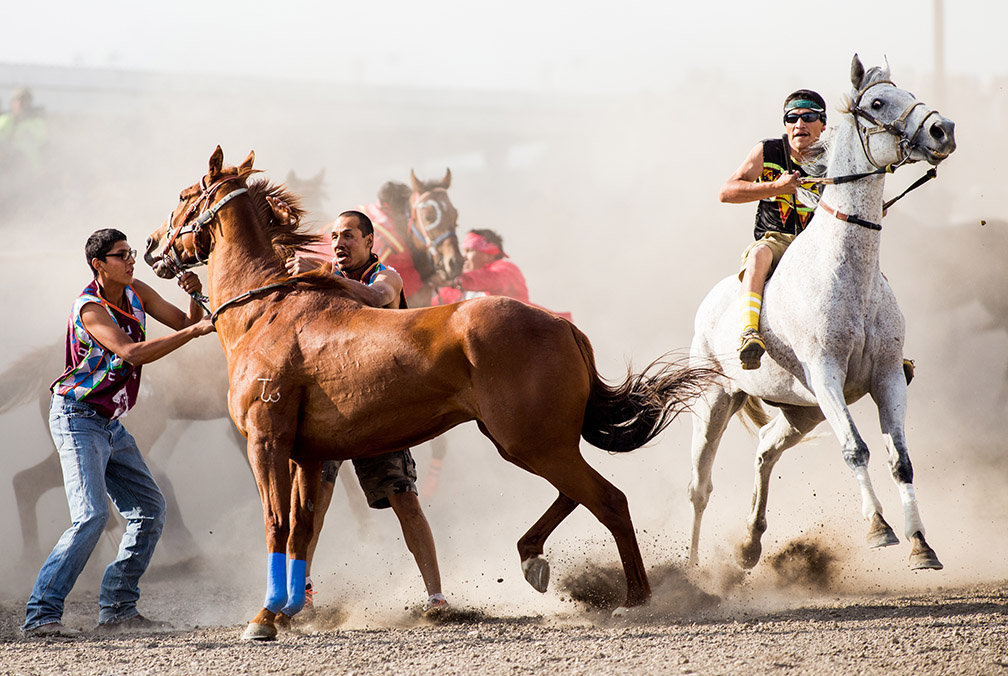
Pictured: a winning photo from Frost's portfolio. Pikunii Express team members try to gain control of one of their horses as a member of team whitecap takes off  during the Indian Relays at the North American Indian Days in Browning, Montana on July 11, 2015.  Photo by Evan Frost
Pictured: a winning photo from Frost’s portfolio. Pikunii Express team members try to gain control of one of their horses as a member of team whitecap takes off during the Indian Relays at the North American Indian Days in Browning, Montana on July 11, 2015. Photo by Evan Frost

“His submission of eight images showed vision, humor, action and impact,” Lurgio said.
Above all they were solid storytelling images.”

Lurgio said Frost was able to put his skills to the test through a summer internship at the Great Falls Tribune.

“That hard work in the professional world rewarded him with a group of solid images that earned him a top-20 finish,” he said. “This is a testament to the importance of the professional internship experiences our students pursue.”

Frost worked as the photo and video editor at the Montana Kaimin during fall semester of 2015, as well as the multimedia editor for the 2016 edition of the Montana Journalism Review. Montana Kaimin adviser and UM journalism Professor Nadia White worked with Frost during fall semester.

“Evan combines a keen eye with a sense of community,” she said. “He’s the kind of student that rolls up his sleeves and gets things done.”

To see Frost’s work and recent projects, visit his website at http://www.evanfrostphoto.com/.

MJR publishes its 2016 edition

The new issue of Montana Journalism Review (MJR) is fresh off the press, produced by an all student staff from the University of Montana’s School of Journalism. The magazine is dedicated to holding a mirror to the news media in Montana and other western states, reporting and interpreting trends that affect journalists in this part of the country.

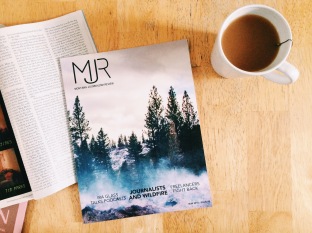
Photo of the printed edition of MJR 2016
Photo by Celia Tobin.

“Everyone who’s interested in journalism in the West must read this issue,” said Associate Professor Henriette Lowisch, who serves as MJR’s editor-in-chief. “It provides a fresh look at questions we media people obsess about, from wildfire coverage to free speech.”

Issue 45 is built around the theme “burn,” with a cover story analyzing what gets lost in often sensationalized coverage of the wildfires that are so much a part of the western landscape. Other features examine how newspapers cover anything from state politics to the new Cannabis beat. Cutting-edge scientists speak out on overlooked stories; freelancers get tips on how to make their work pay, and radio icon Ira Glass offers career advice.

Students on the staff of Montana Journalism Review receive a crash course into the world of producing a high quality magazine.

“Creating MJR is one of the most authentic experiences students can have while still in the classroom,” said Managing Editor Nicky Ouellet, a graduate student. “I’m really proud of what we’ve created, and the immense energy and dedication our staff poured into this issue.”

As other classes ramped up in September, some students of the capstone class that produces MJR were already reporting, writing and photographing on deadline. Others chased down outside contributors, who often had far more years of journalism experience than their newfound editors. For the first time, some of the stories were published on Medium.com, an alternative story platform that specializes in long-form work.

This year’s MJR team worked on improving the fact-checking and copy-editing system for increased accuracy and a more effective workflow. Corrections are now easy to find on the magazine’s newly designed website.

All stories, along with past issues of the magazine, are available online. The print magazine, which is sent to subscribers across the North America and even Europe, can be ordered through the website.

By Andrew Graham