Wall Street Journal, Bloomberg Journalist to Lecture at UM

Journalist and novelist Ken Wells will deliver the eighth annual Jeff Cole Distinguished Lecture at 7 p.m. Monday, Feb. 29, in the University of Montana School of Law Room 101. The event, hosted by the UM School of Journalism, is free and open to the public.

photo of Ken Wells standing on a mountain edge after a hike.
Wells also dabbles in blues and jazz guitar and songwriting and cooks a mean Cajun gumbo.

The talk, “Not Your Grandpa’s Business News: Confessions of an Accidental Business Journalist,” is part of a series of lectures honoring Jeff Cole, a 1980 UM School of Journalism alumnus who worked as an aerospace editor at The Wall Street Journal and died in a plane crash while on assignment in 2001.

According to the bio on his website (http://bayoubro.com/), Wells grew up in Bayou Black, Louisiana, where his father “was a part-time alligator hunter and snake collector and full-time payroll clerk for a local sugar mill” and his mother was “a homemaker and gumbo chef extraordinaire.” Wells began writing stories for his hometown paper when he was 19 years old and served as editor from 1973 to 1975. After graduating from the master’s program at the University of Missouri School of Journalism, he worked as a reporter for the Miami Herald for four years and was a Pulitzer Prize finalist for his series on how an agribusiness drainage system was destroying the Everglades.

Wells joined The Wall Street Journal in San Francisco in 1982, covering a variety of stories across the West and writing the popular Page 1 “middle column” feature. He transferred to its London branch in 1990 and traveled extensively, reporting on the first Persian Gulf War and nonracial democracy in South Africa. Wells moved to the New York branch in 1993 and worked as both a writer and editor, with two of his reporters winning Pulitzers. While working in New York, he won the American Society of Newspaper Editors’ distinguished headline-writing award in 1994. He joined Bloomberg News in 2009.

Wells also has written five novels about Cajun culture in Louisiana and two nonfiction narratives. He has edited two anthologies of The Wall Street Journal’s front-page stories. He currently serves as an adjunct faculty at Columbia University’s graduate School of Journalism. He received an honorary doctorate from Nicholls State University and an induction as a Louisiana Legend by Louisiana Public Broadcasting in 2009.

In 2015 Wells left Bloomberg News to work on a book about the “social and cultural history of gumbo.” It is scheduled to be published in 2017. To read more about Wells, visit his website at http://bayoubro.com/.

Founded in 1914, the School of Journalism is now in its second century of preparing students to think critically, to act ethically and to communicate effectively. They were recently named as one of the “Top Ten” journalism programs in the country by the Radio Television Digital News Association. Check out the website at jour.umt.edu.

This news release is also online at:http://bit.ly/1nADY6G

Students study Fashion Photography during J-term

When photojournalism professor Keith Graham asked his students what other types of photography they wanted to explore, three distinct themes emerged: the outdoors, travel and fashion. While January in Montana might not be the best time to teach class outside, the three-week winter term is perfect for delving into the world of fashion photography, first offered in January 2011.

Globally, the fashion industry is worth over a trillion dollars. Graham says fashion photography crosses commercial and editorial borders, so it helps stretch opportunities for photojournalists as editors and freelancers.

Photo of woman in dark room in a vibrant red dress
Photo by Kira Vercruyssen, from the collection “Red.”

Kira Vercruyssen, a UM senior from Honolulu, Hawaii, said that the class was a fun break from traditional journalism, since students had the chance to trade their role as a reporter for one of a creator. “It was really fun to make these ideas in your head come to life,” she said.

Students directed their own photo shoots, using friends and co-workers as models. However, for the first project Graham made students step in front of the lens and take their own self-portraits. Vercruyssen said it was good for them to understand what it felt like to be a model, and that it helped her when she had to direct her models and capture strong angles.

Once Graham revealed the theme for each photo shoot, students had no other restrictions “besides time and imagination.” Themes ranged from Coco Chanel’s classic “little black dress” to “red” to “replication,” where students had to find a professional fashion shot and capture the same image with their models. “It might look easy,” Graham said, “but can you try to re-create it?”

Both the “denim” and “futuristic” shoots led to more iconic shots, including Bruce Springsteen’s 1984 Born in the USA album cover and Grant Wood’s portrait of the American Gothic.

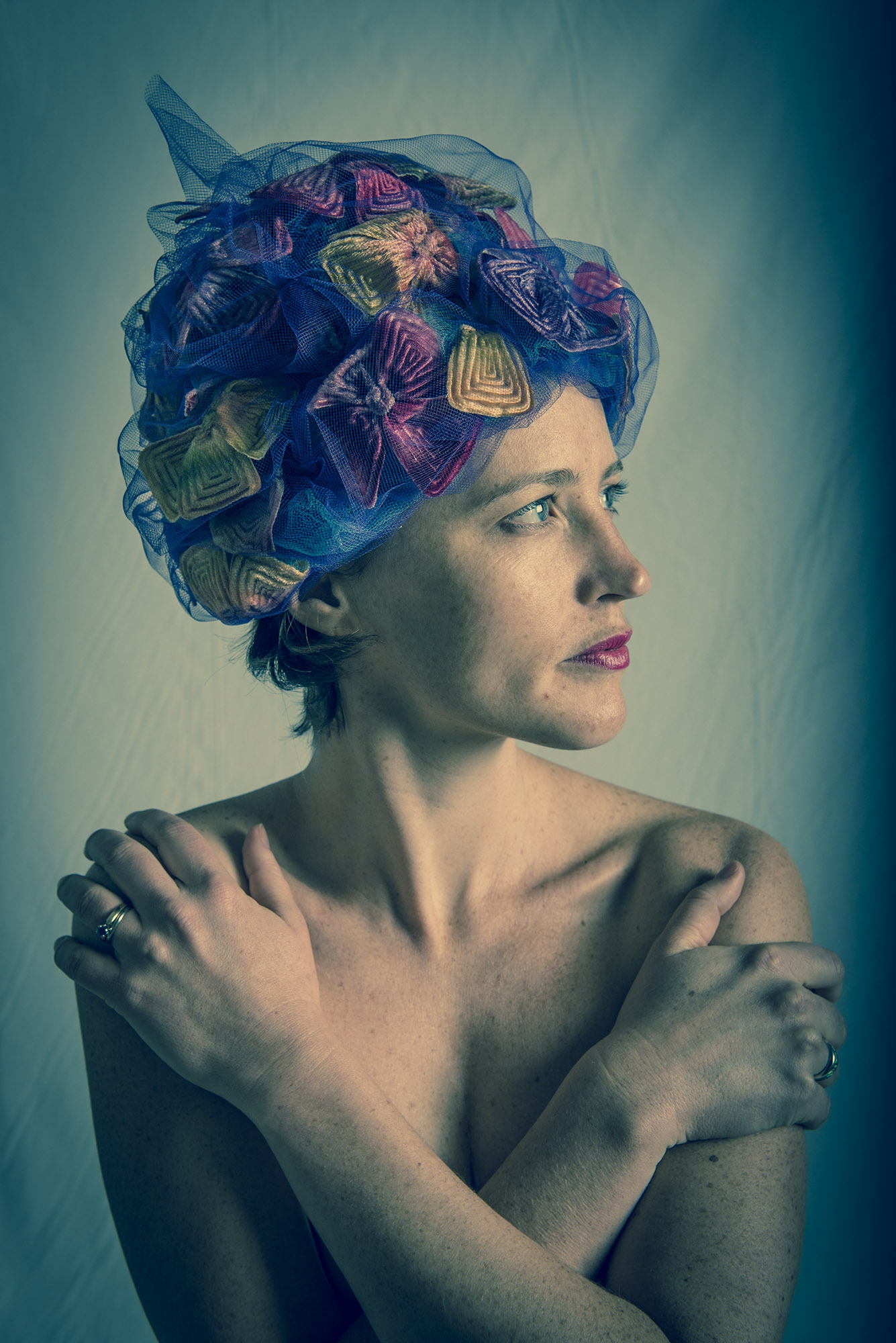
photo of woman wearing multi-colored cap
Photo by Kira Vercruyssen, from the collection “Hats.”

These shoots gave students the freedom to work both in the studio and around town. One of the highlights for Vercruyssen was getting permission to shoot inside the old Mercantile building in downtown Missoula. She also rented a collection of vintage hats from a local theater company for her final free-topic project.

Photo of woman in leather jacket in an empty room with many windows
Photo by Kira Vercruyssen, from the collection “Mercantile.”

Graham challenged the class to create narrative arcs within each campaign and consider what made their images visually and emotionally compelling for an audience. In addition to these spreads, they experimented with diptych photography, where two photographs are placed side by side to make an artistic statement.

With a standard week’s schedule compressed into a single day, all this kept the class busy.

“This kind of immersion is a very useful way to learn,” Graham said. “They produce stronger, better work as a result.”

Vercruyssen chose to attend the University of Montana for its strong journalism program, which is currently ranked 8th in the nation. For her, this class was “like a breath of fresh air” that re-charged her passion for photojournalism as she prepares to graduate this spring.

by Jana Wiegand

Biogeochemistry Professor and J-school Collaborate through NSF Grant

When University of Montana biogeochemistry Professor Cory Cleveland begins a new project in Panama this summer, a young journalist will be coming along for the ride.

Cleveland will build on his long-held conviction that “a fundamental piece of good science is to communicate it effectively,” when he embeds a graduate student from UM’s Master’s program in Environmental Science and Natural Resource Journalism with his research team to document their fieldwork at the Smithsonian Tropical Research Institute.

A lift-out quote reading “It’s an innovative model of collaboration between journalism and the sciences that we hope will serve as a model for other research efforts at the University of Montana.” Scientists often struggle to convey the meaning of their work to the general public. Cleveland says the approach of bringing in a journalist from the beginning helped his proposal stand out and get funding from the National Science Foundation in a highly competitive application process. It will allow him to focus on his research while at the same time helping to create better communication. “I’m never going to do as well at that as someone who’s an expert and a professional journalist,” he said.

The collaboration benefits both sides. For the School of Journalism, the opportunity to document all phases of the research will allow a student to produce compelling stories about a rigorous scientific experiment that has large potential impacts on humanity, said Associate Professor Henriette Lowisch, the UM J-School’s graduate program director, who collaborated with Cleveland on his proposal.

“This will be a huge challenge for an emerging journalist, who will be able to practice all they’ve learned about making complex research accessible to the public,” Lowisch said. “It’s an innovative model of collaboration between journalism and the sciences that we hope will serve as a model for other research efforts at the University of Montana.” Together, Lowisch and Cleveland will select a journalism graduate student to accompany the research team.

In Panama, Cleveland will be testing whether tropical plants are able to get more nutrients from the soil than scientists have previously thought. Tropical forests are among the most productive on Earth, and remove significant amounts of the greenhouse gas carbon dioxide (CO2) from the atmosphere. The plants use CO2 as food to grow, but their growth is ultimately limited by the presence of other nutrients, such as phosphorous, which is scarce in tropical soils. Cleveland’s NSF grant will allow him to study whether tropical plant species have evolved novel ways around this limitation.

The research not only questions conventional wisdom about what plants are capable of, it also carries implications for a world coming to terms with climate change. If Cleveland is right and tropical forests are able to match growing amounts of CO2 in the atmosphere with phosphorous and other nutrients in the soil, they’ll act as better carbon sinks, which could help mitigate the effects of burning fossil fuels.

It’s a good story for an up-and-coming journalist, but how to cover it will be a choice the graduate student will make on the ground in Panama. The result will go beyond the traditional press release that tries to explain scientific research to the public, and instead use story, the craft of journalism, to showcase science.

Both Lowisch and Cleveland said that the project leaves the journalism student room to tell the story as he or she best sees fit.

We’re just going to say here’s an opportunity, come do something,” Cleveland says. “Hopefully that benefits them and they can tell something interesting about what we’re doing, or maybe not. There’s no agenda.”

Lowisch said that part of the reason she is excited about doing this collaboration with Cleveland is exactly that understanding. “Both journalism and science are disciplines of verification, and to be able to do that you need to be independent and Cory Cleveland has understood that.”

Adapted from UM news release by Andrew Graham