Award-Winning Documentary Director, Chad A. Stevens, Speaks At J-School

Chad A. Stevens, director of the documentary “Overburden,” tried out two other titles for his film before settling on the third. Appropriately, Stevens’ presentation at the UM School of Journalism on Wednesday, February 24th, also came with three potential titles: “The Life, Death & Afterlife of a Documentary,” “How in the World did I Survive this Thing?” and “Thank God for Talented Friends and Box Wine.”

“Overburden” played at the Wilma Theater as part of the 2016 Big Sky Documentary Film Festival later that same day. The film follows two women in the heart of Appalachian coal country and their fight to save Coal River Mountain from the Massey Energy Company after an underground fire kills 29 miners.

Stevens said the first iteration of this project began while he was working on his master’s thesis at Ohio University. However, his moment of inspiration began several years earlier, in 2003, during his time as a photojournalist-in-residence at Western Kentucky University. One day, Stevens and a friend were driving through the hills when they crested a ridge and Stevens got his first look at a mountain top removal site. “There was a shocking amount of destruction,” he said.
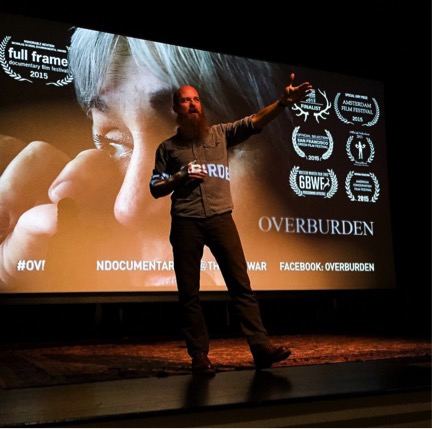
Chad A. Stevens speaks to the audience a screening of “Overburden” in Boulder, Colorado.
Chad A. Stevens speaks to the audience a screening of “Overburden” in Boulder, Colorado. Photo by Erin Hull.

Originally Stevens focused on the environmental aspects of coal mining. He photographed events at the Mountain Justice summer convergence and followed the activists who chained themselves to bulldozers at the top of Coal River Mountain. Yet Stevens realized that this story lacked the intimacy to connect with a broader audience. He looked to the valley where people lived right below the mining sites, whose blasts shook their homes’ foundations.

“I started to have this idea that maybe it could be more,” Stevens said. “I was like, 100% heart. I have to do this no matter what.”

It took Stevens about two years to gain the trust of one of his main characters, Lorelei Scarbro, who had seen plenty of journalists disappear after getting their pictures and quotes from the community. Yet Stevens referred to time as a gift and said it allowed him to understand what mattered most to Scarbro and her battle against coal.

“I was so damn stubborn and wouldn’t leave,” Stevens said, and his patience paid off. “To be there when her grandson was born—that never would’ve never happened without that time.”

One of the project’s major turning points came on April 5th, 2010, when a methane leak and an errant spark caused an explosion in the nearby Upper Big Branch mine.

“As you can imagine, that deeply impacted the community,” Stevens said. “And of course, it changed the film as well.”

A second main character emerged—a pro-coal activist whose brother died in the explosion and spurred her to join Scarbro’s fight.

Stevens also realized that the film’s central theme switched from an environmental perspective to more economy-based story, which explored how extraction-based economies limit local communities.

During the production process, Stevens licensed some of his footage and sold it to organizations that were working on tangential stories, as long as he knew they wouldn’t overlap with “Overburden.”

“I actually paid an editor to edit my film because I felt too close to it,” Stevens said.

Looking back on this ten-year project, Stevens reminded the room full of UM Journalism students about the importance of reaching out to others for help and the importance of remaining humble, because “it’s always bigger than just us.”

Stevens also spoke of the potential that comes from “opportunity blindness.” He said, “When you first start off, there’s no way to know what doors will open down the road. You just got to put it out there.”

While funding such projects remains a challenge for today’s journalists, one of Stevens’ teachers once told him, “Sometimes you do what you gotta do to feed your belly. And sometimes you do what you gotta do to feed your soul.”

Now a tenured professor at the School of Journalism and Mass Communication at the University of North Carolina in Chapel Hill, Stevens has his own mantra for students to learn.

“It’s all about collaboration and community,” Stevens said. “When we care, we as the story-tellers care, that care transfers.”


“Overburden” is currently available for rent on iTunes, Amazon, Google Play and Vudu. Check the film’s website or follow its Facebook or Twitter accounts for details about upcoming screenings.

To learn more about UM J-school affiliates reporting on coal communities in Montana, check out second-year graduate student, Andrew Graham’s contributions to National Geographic’s blog The Great Energy Challenge, and adjunct professor, Matthew Frank’s publications on Mountain West News.

By Jana Wiegand
Student Profile: Joe Lesar, Master Behind The Camera & Devoted Runner

Senior broadcast major, Joe Lesar, could have graduated in the fall, but he didn’t want to pass up all the great opportunities the J-school offered in the spring semester. During Fall 2015, Lesar took UM News, where the students produced weekly televised and online stories. As a photographer, Lesar not only supported his reporters, but also produced some of his own “one-man-band” segments for the program.

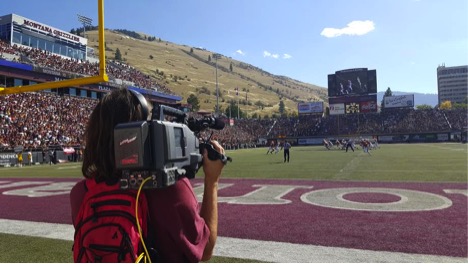
Joe Lesar in the end zone during the Griz v. NAU, September 2015. Photo by Peter Riley.

Every spring, the J-school offers an upper-level elective called Student Documentary, where the students produce an hour-long documentary for Montana PBS. Lesar wanted to experiment with different forms of narrative story-telling; plus, when he realized that most of his cohorts from UM News were feeding into Student Doc, Lesar said, “We worked so well together, I would’ve felt left out if I didn’t do Doc with them.”

Spring 2016 also marked the last semester when Lesar could compete as at student athlete at UM. Lesar ran track at McQueen High School in his hometown of Reno, Nevada, and he wanted to finish his collegiate career as a runner on a strong note. While Track & Field is Lesar’s strongest sport (notably the 400m, 800m and Triple Jump), he also joined the Cross Country team, where the standard men’s 8K race stretches 10 times farther than his longest track event.

However, sports provided an important entryway into another avenue of journalism for Lesar. One day, he was walking through the Adams Center and happened to run into the director of Griz Vision, Abe Kurien. From a simple conversation about shared July birthdays, Lesar landed a job as a videographer for Griz games—football, basketball and volleyball.

Kurien told Lesar, “Come in and check it out, shadow us at some games, and if you’re interested, come back and we’ll have a job for you.”

Now Lesar’s on his second season shooting with Griz Vision and he runs a floor camera right under the basketball hoop. His ability to know what shots Kurien wants covered, without receiving direction via earpiece, means that Kurien can depend on Lesar to get the job done well.

“Joe, in particular, having already anticipated that shot, means so much,” Kurien said. “Because he knows what’s coming during the plays.”

By now, Lesar considers it second nature.

“You just follow the ball,” he said. “If someone scores, you zoom in on them and get the Hero Shot.”

This work can become more challenging during home Griz games in football season because of the variable weather conditions. Yet fellow J-school senior, Peter Riley, who also works for Griz Vision, said, “It’s a great way for the Journalism community to be involved with the greater campus community.”

“I’m getting paid to go to the home games and be on the ground, with all the action,” Riley added. “That’s a nice reward.”

Lesar agrees that he enjoys being close to the action and seeing the interactions between coaches, players and referees. During basketball games, “The coaches get super-animated, and they scream a lot, which is pretty entertaining,” Lesar said. “I always keep an eye on them.”

Kurien said that Griz Vision is an excellent opportunity for broadcast journalism students to work hands on with the cameras. He added, “Joe, I think, enjoys what he does and wants to be a part of every game.”

Scheduled to graduate in Spring 2016, Lesar hopes to stay in Missoula for a while and keep working for Griz Vision, while looking for jobs at local news stations. “I don’t see myself going home,” Lesar said. “There are so many opportunities from here.”

Learn more about J-school student experiences with Griz Vision here, as documented by Sojin Josephson, sports reporter for the Montana Kaimin.

Further interest and inquiries about Griz Vision can be directed to Abe Kurien, via email, agkurien@gmail.com, or via phone, at 406-207-6370.

By Jana Wiegand

Journalism student looks forward to networking in NYC

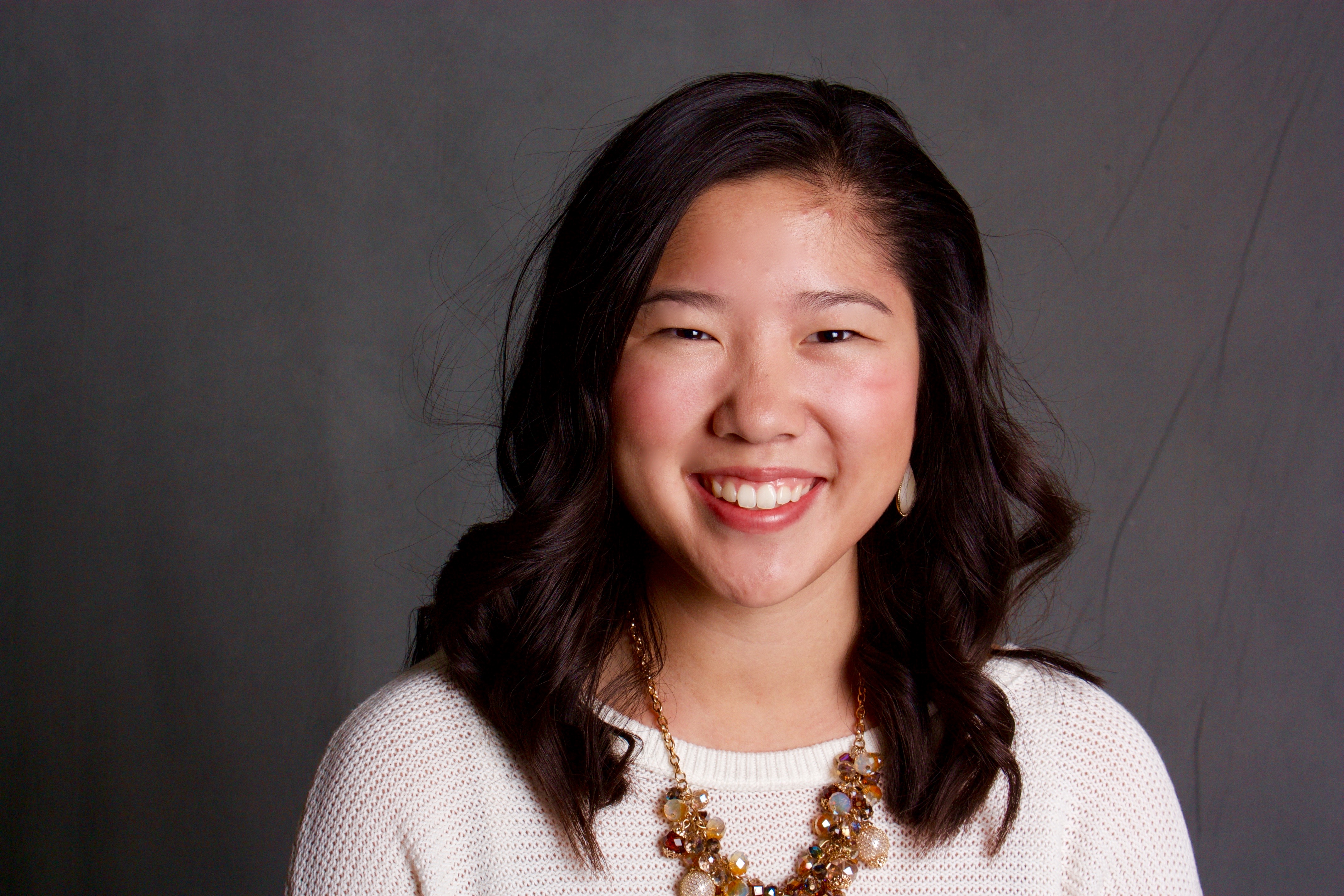
For Sojin Josephson, a 21 year old senior broadcast and print major from Big Timber, population roughly 1,600, New York City has always been something of a fascination. She’s visited before with her mother, she said, and is always fascinated by the city’s energy. December 2nd, she’ll return to New York, this time alone and to attend a two day workshop hosted by the International Radio and Television Society.

Pictured above: Sojin Josephson.

“I’ve really wanted a good opportunity to go to a place I love,” Josephson said, noting that she’s looking forward to a chance to spend some time alone in a city that interests her.

Called the Multicultural Career Workshop, the two days include seminars in digital media, creative production, advertising, research, sales and marketing. There will be panels of media professionals taking questions, and then a full day career fair where Josephson will have the chance to make contacts with major media companies.

Josephson said she applied on a bit of a whim, after Ray Ekness, Professor & Director of Student Success, suggested that she take a shot at the workshop. As a sports reporter for the student newspaper the Montana Kaimin, and a reporter, anchor and producer with UM News, a weekly news segment staffed by senior broadcast students, Josephson has been taking advantage of the opportunities for hands on production by students at the School of Journalism.

While her multifaceted abilities are an asset in today’s job market for journalists, Josephson said she struggles between the two career tracks as she finds both rewarding. For the spring semester, she hopes to do a broadcast internship around Missoula, and get a taste for how that feels.

For now, she’s looking forward to the chance to make some contacts in New York, hand out her resume and immerse herself once more in the energy of the Big Apple.

You can read a remarkable profile by Josephson that recently ran in the Montana Kaimin here.

By Andrew Graham