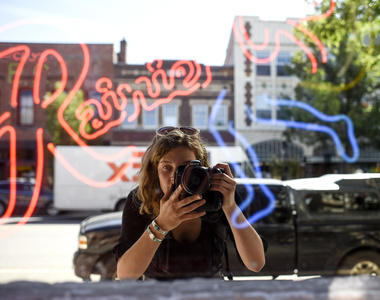
Rachel Leathe developed a love for photography at a young age when her father taught her basic techniques. Her admiration for the craft deepened when she entered high school in Great Falls and had access to a dark room to develop photographs. She went on to study photojournalism at the University of Montana, where she received her degree in 2014.
She was hired by the Bozeman Daily Chronicle in 2015 as a staff photographer and now works as Chief Visual Journalist. She also runs the Chronicle’s Instagram account with her co-worker, Sam Wilson. The Chronicle’s Instagram has 14,600 followers. The Chronicle’s other main platforms, Facebook and Twitter, have 52,207 followers and 20,800 followers, respectively.
Leathe recently answered J-School student Nikki Zambon’s questions over email and the following is a transcript of their conversation, edited slightly for clarity.
Social media is hard for a journalist to avoid, especially a well-established one. Sportswriter, blogger and media personality Ryan Divish uses social media not only to promote his work, but also to post accurate news.
Divish, who studied at the University of Montana, first began covering the Seattle Mariners in 2006 for the Tacoma News Tribune. He now covers the Mariners as a beat writer for the Seattle Times. In an email interview with UM student Payton Petersen, Divish explained how social media affects his job and how he has succeeded as a journalist. Below is a transcript of the conversation, edited lightly for clarity and length.
Q: How do you deal with negative comments on social media?
A: My thinking on this has evolved over the years. When I first got on social media, I would try to respond to everyone. I was using it as an avenue to build up readership and establish myself in the Seattle-Tacoma market. I felt that if I responded to all good and bad, it would give readers the sense that I’m truly interested in interacting and trying to provide information to their specific desires.
I would also use humor and self-deprecation as a method to defuse really angry responses. Nobody likes a preening, condescending schmo. And I wanted to make it very clear that I wasn’t trying to play any level of superiority.
I would also snipe back when I felt it was people being stupid or cruel or ignorant. I would use the quote tweet and fire back with better snark or sarcasm than they tried to use. It probably wasn’t very mature at times. But I’m also not a very mature person. Often those negative commenters would be taken aback or be upset. I would simply tell them. I was a smart-ass prick long before social media and I’m better at it than them.
But now, I find it too exhausting to respond. I will try to clarify if I feel it’s necessary. But usually I just let them yell into the raindrops of the Twittersphere. I don’t block many people because I would never give them the satisfaction of knowing or saying that I blocked them, but I will mute the hell out of them.
Tessa Nadeau is a reporter for the ABC Fox Montana news. She started working right out of college when she graduated from the University of Montana with a degree in broadcast journalism. She says social media has always played an important role in her work.
She recently answered questions from UM student Cathleen Doisher over email about how she uses social media in her work. Below is a transcript of their conversation, edited lightly for length and clarity.
Q:Do you often use social media to display your work as a journalist? What platform is your favorite to use?
A: Yes, I often use social media for work. Knowing how to utilize social media as a journalist is really important, especially when trying to reach the younger generation. It’s a great tool to use when trying to get information out to people quickly and right when the news is taking place. My favorite platform to use is Instagram. I like being able to take a quick picture or shoot a video of whatever is taking place and update my followers that way.



 Montana Journalism