
Social Media Best Practices: Q&A with “Risk!’s” Brad Lawrence

By Kai Williams

Collecting and coaching stories from all walks of life, from all around the world, Brad Lawrence has the difficult task of narrowing down the stories which are shared on a weekly podcast into bite-size pieces to entice social media users to tune into the show.

Lawrence is the casting director, story producer, and social media manager of “RISK!,” a live storytelling show and weekly podcast hosted by Kevin Allison. “RISK!” shares true stories people never thought they’d dare to share in public. As of 2018, on average the podcast has one million monthly episode downloads and has upwards of 14,000 likes on Facebook. “RISK!” is active on Facebook, Instagram, and Twitter, as well as holding group discussion forums on a private Facebook page and within its own subreddit.

Lawrence has been a part of the “RISK!” team since 2016. He’s a storyteller himself, but also a teacher, writer, and hosts his own science fiction audiobook-as-podcast, “Maxine and the Planets Unknown.”

“RISK!” prides itself on showcasing a wide array of storytellers from as many different backgrounds and experiences as possible. With that, Lawrence has the opportunity to consume all types of stories and work with the storytellers to portray those stories in a condensed and meaningful way for social media.

Lawrence answered questions from New York via Zoom with University of Montana journalism student Kai Williams. Some questions and answers have been edited and shortened for clarity.

Q: You are the casting director, story producer, and social media manager. Can you tell me what each of those things mean regarding “RISK!?”

A: The casting director side of it is reading the pitches as they come in, deciding if a story’s the right fit for “RISK!,” getting a recording and guiding people through that entire process to the point of actually being cast on the show, or not, depending how it all goes.

Then then the story producer part is when we’re actually working on a story and the coaching process falls under that heading. Corralling all the recordings; making sure who needs to hear the recordings hears them; sitting in on the casting meetings and making a case for like, “I think this story works for this reason,” or whatever reason, or, “We think this person should be moved to radio-style or receive more notes in this.” And that’s a lot of people. You end up talking to people on the tech side, the production side, and that kind of stuff, as well as Cyndi [Freeman, casting director and story producer] and Kevin [Allison, host and creator].

And then the social media side is—I am the cheapest graphic designer in the whole wide world because I’m a hobbyist graphic designer. So, a lot of the things you see on Instagram are things that I designed because I’m willing to do it, essentially. A lot of guidance from JC Cassis [producer and business manager] on that. If you look at the “RISK!” Instagram feed and the Story Studio Instagram feed, you will see lots of my graphic design with input from JC and JC oversees that I’m within certain guidelines and guardrails. I run all the social media accounts. But all the aesthetic principles and the voice of those accounts—that was decided by JC and then communicated to me and it’s my job to stay within those bounds, which I mainly do pretty well.

Continue reading “Social Media Best Practices: Q&A with “Risk!’s” Brad Lawrence”
Social Media Best Practices: Q&A with Montana Public Radio’s Katy Wade

By Nicolas Kuster

Katy Wade is the new community media specialist at Montana Public Radio. She’s a 2019 graduate of the University of Montana School of Journalism. Her radio station has 2,806 followers on Instagram, 18,500 followers on Twitter, and 13,432 likes on Facebook. Wade’s “Big Why” podcast is one of the featured elements of the Montana Public Radio social media page.

UM student Nicolas Kuster interviewed Wade over Zoom about her work and her approach to social media. Below is a transcript of their conversation, edited slightly for brevity.

Q: What is the most fun part of your job? What do you do on a daily basis?

A: So, the most fun part of my job is that every day looks kind of different. I work on a lot of little projects but mostly I’ve been working with our news team and our development team to kind of bring in new listeners. And kind of see which listeners we’re talking to and which listeners we aren’t talking to and how to get those people more engaged with the station.

So, that can look like doing some social media work. That can also look like starting a podcast. I helped start a listener engagement podcast called “The Big Why,” and I have also been working on different ways to get sponsorship to kind of help bring in some more money to get those listeners.

Q: What is your biggest and smallest demographic?

A: It’s kind of hard to get a record of who we are listened to most, but I do think we have quite a lot of older listeners. We’ve got quite a variety of listeners as well, which is cool. But we did do a source audit where we looked at everybody over a 3-month period from last summer that we use as the source in a story and kind of broke down the demographics of that. It seems like the people that we talked to the most are older and more white and everything else is pretty matched with the Montana census. It does seem like people we were kind of missing out on, our smallest demographic that we were missing, were younger voices and rural places. So, people in Montana who live kind of off-the-grid, or, you know, not in big cities.

Continue reading “Social Media Best Practices: Q&A with Montana Public Radio’s Katy Wade”

Good Work Wednesday: Oct. 12, 2022

by Jocelyn Harris

In an effort to celebrate and highlight some of the best journalism happening in Montana, in environmental and science journalism as well as the good work being produced by our UM J-School alumni, each week, the School of Journalism is compiling these stories in this new feature: Good Work Wednesday. Look for it every week and if you have suggestions of journalism works we should highlight, email Good Work Wednesday curator and grad student Jocelyn Harris at jocelyn.harris@umconnect.umt.edu.

Top Montana news stories:

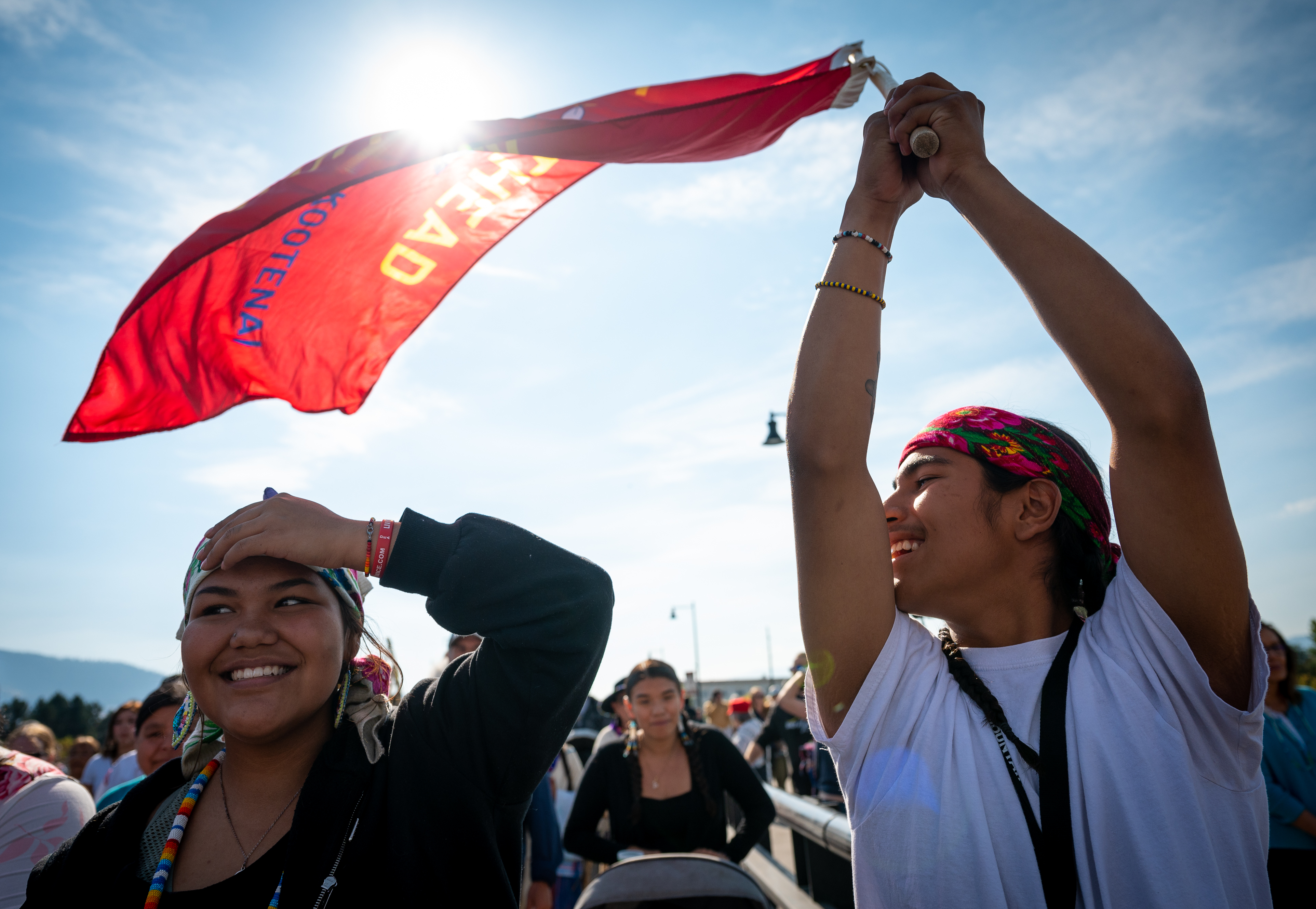
1. Indigenous Peoples Day: Beartracks Bridge in downtown Missoula dedicated (by David Erickson / Missoulian)

Loui James, right, waves a Confederated Salish and Kootenai Tribe flag as he walks across Beartracks Bridge in Missoula alongside his sister Jessi, left, during a dedication ceremony and renaming of the city’s historic downtown bridge on Oct. 10. On Monday CSKT, Séliš-Ql?ispéCulture Committee, Missoula County and the City of Missoula invited the general public to take part in the ceremony and celebration of Indigenous People’s Day. Photo by Antonio Ibarra / Missoulian. Ibarra is a 2022 graduate of the University of Montana School of Journalism. Photo used with permission.
“It is so fitting to name this bridge in honor of Sxʷúytis Smx̣e, Grizzly Bear Tracks, a leader of the highest stature among the Salish people. This is a big moment in the building of mutually respectful relationships between the Confederated Salish and Kootenai Tribes and the city and county of Missoula," said Martin Charlo, CSKT Tribal Council secretary.


2. New Big Sky wastewater plant designed to protect Gallatin River from algal blooms (by Helena Dore / Billings Gazette)
“We’ll take this plant about as far as any plant can go in terms of removal of those nutrients, because they are what set off algal blooms in our watersheds,” said Scott Buecker, wastewater practice leader for the consulting firm AE2S Engineering.

3. Officials say fentanyl crisis in Montana is worsening (by Jonathan May / NBC Montana)

“With fentanyl in the area, it’s actually beginning to overtake meth as a drug of choice,” Missouri River Drug Task Force commander Nathan Kamerman said.

4. Local leaders meet to discuss increase in homelessness (by Denali Sagner / Flathead Beacon)

Excerpt: Kalispell’s homeless population is larger than that of bigger cities such as Billings, Helena, Great Falls, Bozeman and Butte, an alarming point of comparison that community members discussed at length during the Oct. 6 meeting. 

5. Gianforte’s response to Biden request for marijuana pardons (Max Savage Levenson / Montana Free Press)

“The governor will continue to evaluate clemencies submitted through the Board of Pardons and Parole on a case-by-case basis, in accordance with [state] statute,” spokesperson Brooke Stroyke told Montana Free Press Friday.

Science and environmental stories:

  1. The bodies in the cave (by Rachel Monroe / The New Yorker)

Native people have lived in the Big Bend region for thousands of years. Who should claim their remains?

2. A California city’s water supply is expected to run out in two months (by Joshua Partlow / The Washington Post)

Excerpt: That looming threat has left city officials racing between meetings in Sacramento and phone calls to the U.S. Bureau of Reclamation seeking to increase their water supply. Some residents have begun stockpiling five-gallon water jugs in their homes, while many expect major spikes in their water bills. If Coalinga can’t find relief, it would be forced to buy additional water on the open market at exorbitant prices that could swamp the city’s budget.

Student/Alumni Story of the week:

Critics worry Holland Lake Lodge plan would hurt the environment and nearby communities (by Austin Amestoy, ’22 / Montana Public Radio)

Amestoy, who graduated last spring, reports on a controversial plan for the storied Holland Lake Lodge in the Swan Valley. As always, Amestoy looks for the context, the undercurrent of the story, which in this case is the uniquely western tug-of-war among recreation, tourism, environmental and wildlife concerns and the gentrification of some of the west’s most beautiful places.