Journalists On Social Media: Q&A with Madison Dapcevich

By Daisy Coyne

Madison Dapcevich is a science reporter with Lead Stories, a fact-checking website that searches the internet for posts that contain false or misleading pictures or information, who has been using social media throughout her career for a diverse list of publications and projects. She started using social media about 20 years ago as a way to personally connect with people. But, as social media has grown and changed throughout the past few years, so has Dapcevich’s relationship with it. She has created and posted Instagram reels during her time as a Digital Content Coordinator at Nautilus Live, an ocean exploration trust, while doing deep-sea research and is now a science reporter for Lead Stories where she fact-checks social media posts for accuracy and falsehoods.
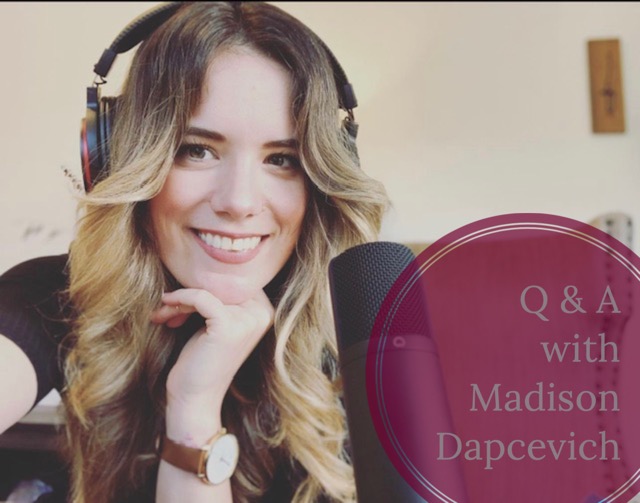
Dapcevich has created an online presence for herself on many social media platforms, both for personal and professional use. Dapcevich has about 1,300 followers on Twitter with a blue check mark next to her name and has about 4,500 followers on Instagram. In an email interview with UM Journalism student Daisy Coyne, Dapcevich answers some questions about her work. Below is a transcript of their conversation, edited for brevity and clarity.

Q: How has social media impacted your career? 

A: Social media has impacted my career on a variety of levels, but I will speak to how it influences my current role. I currently serve as a science reporter with Lead Stories, one of the independent fact-checking agencies that Facebook, and other social media companies rely on to document falsehoods online.

Social media has allowed for mis- and disinformation to thrive online and has further siloed already polarizing political ideologies. For all the positive aspects of social media — the dissemination and accessibility of information, among them — there is an equal amount of harm being done by nefarious actors who share, either intentionally or unknowingly, false information.

My role is to fact-check social media posts for their accuracy and to flag posts that lack context and nuance or are blatantly wrong. In short, my current role requires that I be immersed in social media.


Continue reading “Journalists On Social Media: Q&A with Madison Dapcevich”

Social Media Best Practices: Q& A with Nate Schoenfelder of the Montana Free Press

By Tyler Johnson

Nate Schoenfelder is the director of audience engagement at the Montana Free Press. Schoenfelder specializes in marketing and communications. Schoenfelder is from Idaho and, prior to serving as the director of audience engagement at the Montana Free Press, was on the leadership team of a software company called Pingman Tools as their marketing communications manager.

Montana Free Press is present on various social media platforms which include Facebook, Twitter, and Instagram. Their largest following is on Twitter where they have about 9,000 followers. They remain active on all of their social media platforms. UM student Tyler Johnson interviewed Schoenfelder via email to get a deeper look into the Montana Free Press social media practices. Below is a transcript of their conversation.

Q: Are there any guidelines that you follow when generating a social media post and if so, what are they?
 
A: So, our post guidelines are not formalized, but our biggest north star is to always strive to provide value to a reader. While we often have audience and fundraising needs that we support through social media posting, we view all our social posts through the lens of our role as a news organization and our responsibility to provide information to the public and to offer a venue (flawed as it may be) for public discourse. Our posting is always done with an explicit goal in mind, be it to drive traffic to a story, generate newsletter signups, or solicit audience feedback.

Q: How many people do you have working on your social media team and what are some of the responsibilities?

We have a team of three who oversee our social accounts. As the Director of Audience Engagement, it is my responsibility to set higher-level goals and guide our social media strategy to achieve our objectives. At this point, I will rarely draft social posts. However, outside of our social posts promoting new reporting, I review and approve the content of our posts.

We have a marketing contractor who provides social media support, which includes drafting social posts and managing the day-to-day maintenance of the accounts.

Our Production Editor is responsible for drafting and scheduling all of our social posts for story promotion. Our publishing tools allow us to schedule posting directly from our content management system, so social post drafting is included in the story publication workflow.

Continue reading “Social Media Best Practices: Q& A with Nate Schoenfelder of the Montana Free Press”

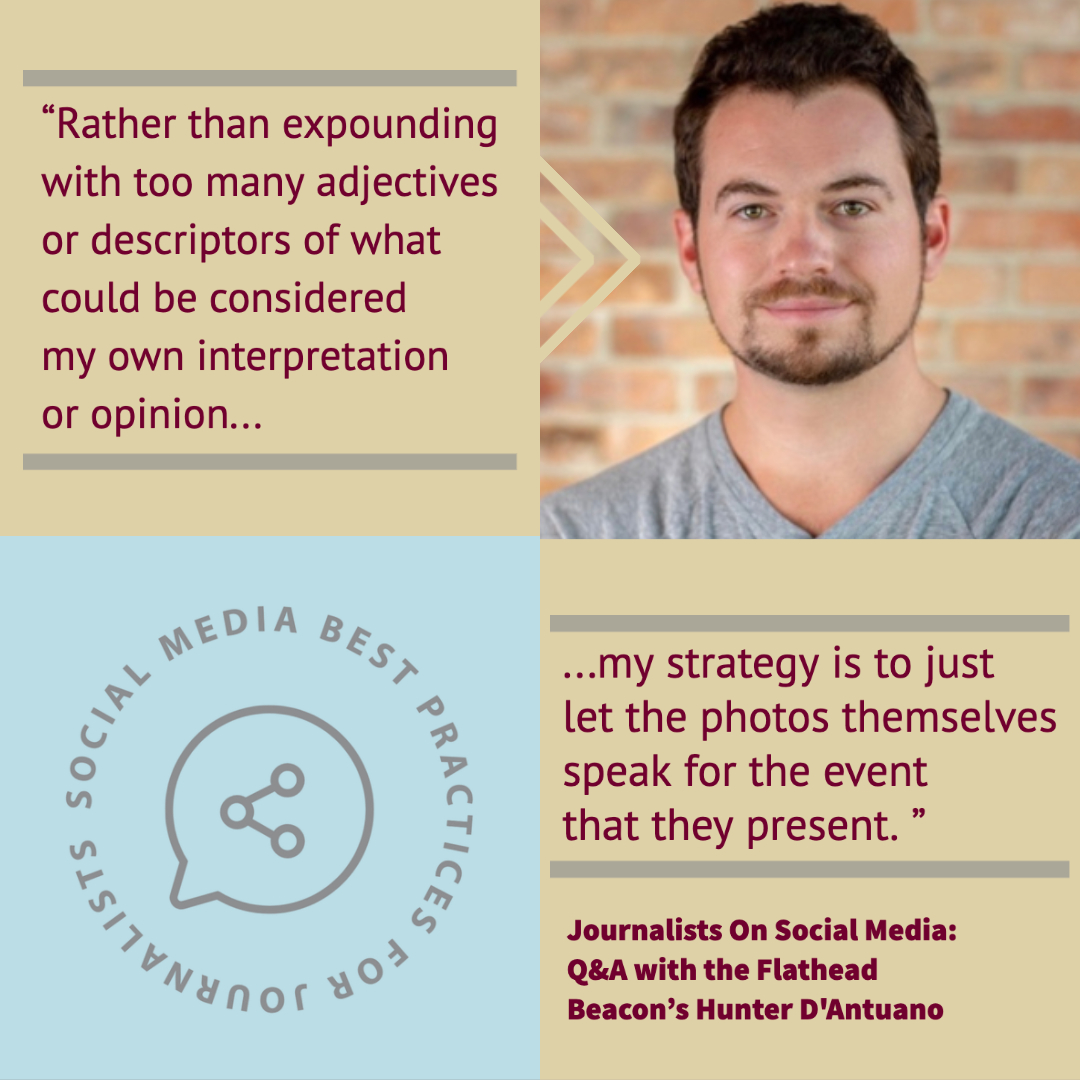
Journalists On Social Media: Q&A with the Flathead Beacon’s Hunter D’Antuano

By Ashley Miller

Hunter D’Antuano is a reporter, photographer, & media director for the Flathead Beacon, an independent weekly newspaper located in Kalispell, Montana that covers the Flathead Valley, Glacier National Park, The Flathead Reservation, The Blackfeet Reservation, as well as the more rural areas of Northwestern Montana. D’Antuono is a UM school of journalism alum who joined the Flathead Beacon in 2019. He has produced photographic and written content for numerous publications including the The New York Times, The Washington Post, Montana Outdoors, The Missoulian, The Montana Kaimin, etc.

In a phone interview with UM student Ashley Miller, D’Antuano discussed his own best practices on social media as it relates to his work as a journalist. Below is a transcript of the conversation, edited lightly for clarity and length.

Q: How many people do you have working on your social media team and what are some of their responsibilities?

A: We are a small newsroom, so we don’t have a social media team per se, but we do prepare our content for print and our content for online by dividing up the tasks amongst the staff. For example, since I am the media director and photographer, I run the paper’s Instagram while the other members of the staff share the load and post content to Facebook and/or Twitter. I normally take my best shot or gallery and post that weekly to our Instagram to help expose our audience to what we are doing and remind them that the Beacon has things for them to look at. On a personal front I am not super focused on social media as an individual, but I do see the value of it, and I guess I prefer quality over quantity when it comes to my own strategy for Instagram content.

Q: What is your favorite platform to post on? How do you cater your content to different platforms?

A: I wish I could say that there was a scientific formula to it but it typically depends on the type of content. For example, if there is something breaking news like a forest fire, we will typically throw that up as quickly as possible to all platforms. A lot of times on Instagram because we are a weekly newspaper I have a little more freedom, and it doesn’t always have to be the hardest of hard news. Sometimes we can put prettier photos or things that are a little more lighthearted of content that is local and relevant for people to engage with. For myself though I personally like to go for as much variety as possible.

Q: What are some of the challenges you’ve faced while working as a journalist on social media?

A: I guess I kind of think it mirrors what people can sometimes experience on their own social media accounts. It’s like you post something, people don’t agree with it and they get up and arms about it. People can often be unnecessarily nastier online than they would be in person in my opinion. I think that social media is great because it is condensed, more digestible bits of information, but I think it also enhances opportunities for things to be taken out of context for people to cherry pick things and to make a mountain out of a molehill kind of effect. Personally, I don’t always like social media because I think that it can be kind of a train wreck. However, with that, it is kind of a necessary evil because we are in the business of trying to collect and distribute information in an accurate and compelling way, and social media is a part of that landscape.

Continue reading “Journalists On Social Media: Q&A with the Flathead Beacon’s Hunter D’Antuano”